Express
Memorabilia
| Antiques and Collectibles | Real World Antique Malls |
Scientifica Express |
Memorabilia |
Home |
|
|
Cave Memorabilia
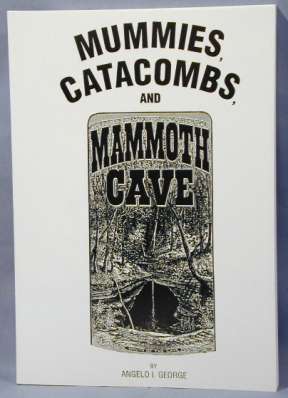
Mummies, Catacombs and Mammoth Cave $16.50 By Angelo I. George, 153 pages, 1994. Short Cave near world famous Mammoth Cave is the repository of at least six native American Indian mummy burials unearthed from 1805 to 1814. Some of these petrified Indian mummies played a central role in the history of Mammoth Cave, Kentucky. Thomas Ashe, a notorious Irish traveler, discovered part of a story connected with the earliest Short Cave burials and described the site in his 1809 book. Having never been to Short Cave, he changed the name and the locale to a great Catacomb near the town of Lexington, Kentucky. Part of Mummies, Catacombs and Mammoth Cave book covers the analysis of the great catacomb mystery and Thomas Ashe’s adventure in the wilds of pioneer Kentucky. A treasure trove of early Lexington scientist, collectors, historians, and museum owners are profiled in this book. The second half of the book discusses the mummies from Big Bone Cave, Tennessee, and in and around Mammoth Cave are investigated in this epic monograph. Purported discoveries of mummies in the far distant regions of Mammoth Cave made the cavern world famous. Its fame grew on the shoulders of Fawn Hoof, the best known of all the mummies. A significant chapter in the history of Mammoth Cave, Salts Cave, and Longs Cave is rewritten. Illustrated with many vintage wood cuts, lithographs, and photographs. The book is the result of over twenty years of research and is documented with over 440 end notes.
Reprint collection contains two articles, "The Saltpeter Works at Mammoth Cave and the New Madrid earthquake," by Angelo I. George and Gary A. O’Dell; originally appeared in 1992, The Filson Club History Quarterly, vol. 66, no. 1, p. 5-22. The second article is the "Effects of the New Madrid Earthquake (1811-1812) Damage to the Mammoth Cave Saltpeter Works, Kentucky," by Angelo I. George; originally appeared in the Journal of Spelean History, vol. 24, no. 1, p. 10-12. These reprints discusses the effects of the most powerful earthquake ever to strike contemporary North America and its effect on saltpeter manufacturing in Mammoth Cave, Kentucky. Earthquake terror stricken workmen, frighten management, and a wrecked manufacturing plant inside the cave cut saltpeter production by one half over a years time. So much damage was done that the cave could not regain its prominence as a saltpeter producer and closed its manufacturing doors at the start of 1814. These reprint articles are a major contribution in understanding early pioneer industrial life and activity in the largest cave in the world.
by Angelo I. George. This is a 1986 reprint from The Filson Club History Quarterly, vol. 60, no. 2, p. 189-217. Discusses the effect of the War of 1812 on the geographic distribution of 133 caves and 6 rock shelters mined for saltpeter and 22 gunpowder factories in Kentucky. Shows that existing roads prior to 1818 were more important saltpeter and gunpowder sighting criteria than any other socio-geographic-geologic presence.
Notes on Making Saltpetre $3.50 by Major George W. Rains; Steam Power Press Chronicle and Sentinel, Augusta, Georgia, 1883, 10 pages. Facsimile reprint of the classic Confederate States of America cook-book on domestic saltpeter making. The reprint is for edification only. An element of caution is needed, because there are certain inherent life threatening dangers associated with the manufacture of saltpeter and its more powerful relative, gunpowder.
by Angelo I. George, 68 pages, 1991. Summary of 3000 years of human occupation in Wyandotte Cave of southern Indiana. Illustrated with 15 antique lithographs with extensive references documenting each historic event. The book separates traditions and lore of the cave with actual events. The book is the first published history guidebook on the cave in seventeen years. New interpretations on historical events presents a greater understanding for the fourth oldest commercial cave in America. Comes complete with documented chronology of historic events in the cave.
by Angelo I. George, 74 pages, 1991. The Bibliography is cross referenced by author and by date of publication. Over 900 citations are assembled for the fourth oldest commercial cave in America. This is the first published bibliography on the cave since 1897. The book is invaluable to anyone desiring to do Wyandotte research on its history, geology, biology, archaeology, exploration, and tourist development. A must for Wyandotte bibliophiles and spelean historians.
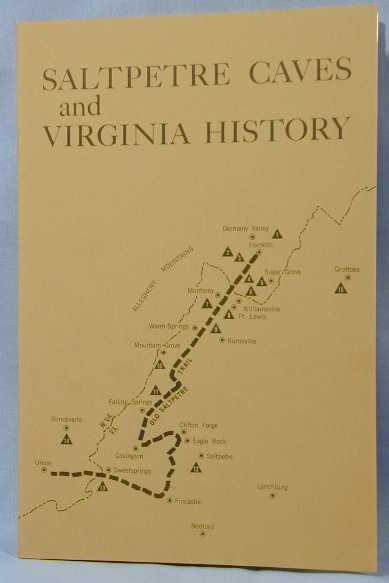
by Burton Faust; reprinted from "Caves of Virginia" by Henry H. Douglas, 1964, p. 31-56. Faust is the first person to study saltpeter and gunpowder productions from caves in the 20th Century. Decades of research and on-site investigation opens a new chapter to saltpeter sites in Virginia and West Virginia, during Colonial, Revolutionary, and Civil War time frame. Capsulated physical description of major cave saltpeter sites are inventoried.
| Top
|
| Antiques and Collectibles | Real World Antique Malls | Scientific |
|
Home |
| Top
Copyright © 1999 HMI | ||||